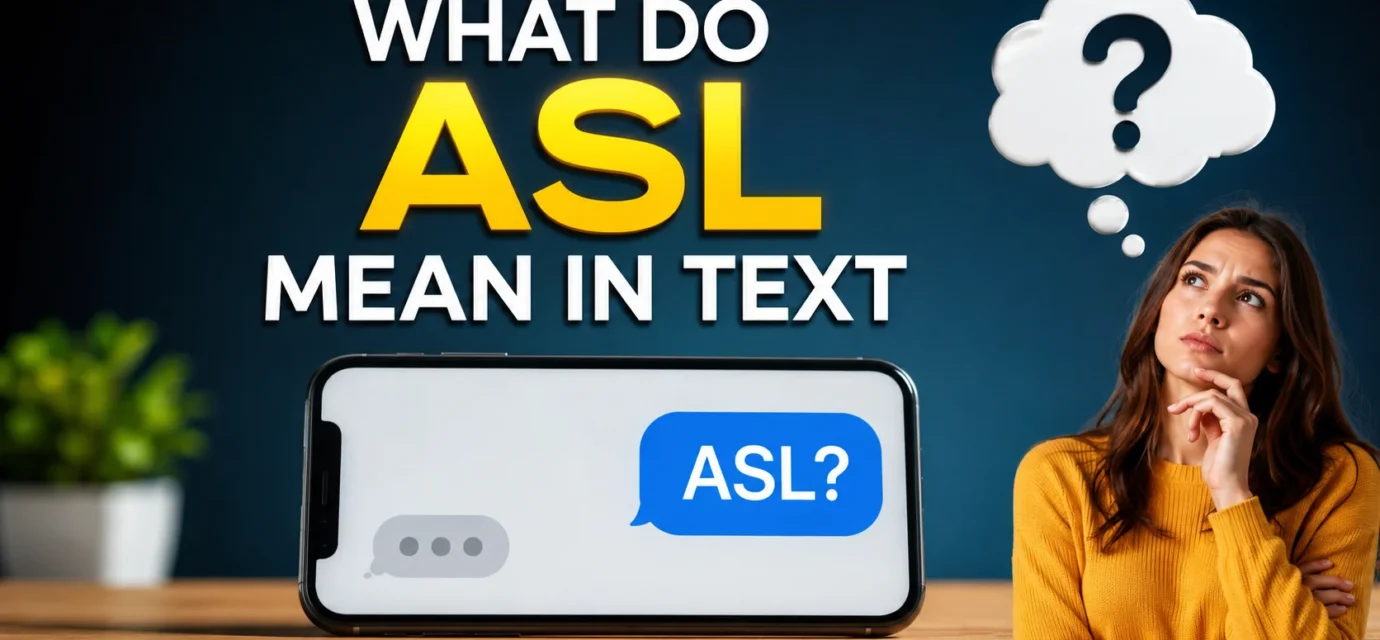

If you have ever seen someone message “asl?” and paused for a second, you are not alone. Text slang moves fast, and one small abbreviation can carry a lot of meaning depending on where it appears.
So, what do asl mean in text?
Most commonly, ASL means “age, sex, location.” It is a quick way someone asks about your basic identity in online chats, dating spaces, gaming communities, or social media conversations.
But that is not the only meaning. In some contexts, ASL can also mean “as hell,” especially in casual posts, comments, and memes. For example, someone might say, “I’m tired asl,” meaning “I’m very tired.”
That double meaning is exactly why people search for it. The same three letters can feel harmless, flirty, rude, funny, or confusing depending on the tone, platform, and relationship between the people talking.
This guide explains the meaning clearly, shows real examples, and helps you understand when ASL is normal, when it is awkward, and when it is better not to use it.
What Do ASL Mean in Text – Quick Meaning
In texting, ASL usually has two main meanings:
- Age, sex, location: A question asking someone’s age, gender, and where they live.
- As hell: A slang intensifier meaning “very” or “extremely.”
The right meaning depends on the sentence.
If someone sends only:
“asl?”
They are most likely asking: age, sex, location?
If someone says:
“That movie was funny asl.”
They mean: That movie was very funny.
Another example:
“I’m sleepy asl rn.”
This means: I’m extremely sleepy right now.
Simple Definition
ASL in text means either “age, sex, location” or “as hell,” depending on how it is used.
When it appears as a standalone question, it usually means someone wants your basic personal details.
When it appears at the end of a sentence, it usually means “as hell.”
Origin & Background
ASL became popular long before TikTok comments and Instagram DMs existed. It comes from early internet chatrooms, especially in the 1990s and early 2000s.
Back then, people entered anonymous chat spaces without profile photos, bios, or usernames that revealed much. Asking “asl?” was a fast way to understand who you were talking to.
Early Chatroom Culture
In old-school chatrooms, a conversation often started like this:
Person A:
asl?
Person B:
16/f/ny
That meant: 16 years old, female, New York.
It was quick, direct, and very normal in that digital culture. People used it because online identity was often hidden. There were no polished profiles or follower counts to check.
How Social Media Changed It
As social media became more visual, the original “age, sex, location” meaning became less common in everyday public conversations.
On Instagram, Snapchat, TikTok, and dating apps, people often already share age, photos, location hints, or personal details. Because of that, asking “asl?” can now feel old-fashioned, awkward, or too direct.
At the same time, another meaning grew stronger: ASL as “as hell.”
This version became common in casual internet slang, especially in comments like:
“You funny asl.”
“That’s scary asl.”
“He mad asl.”
This meaning is especially common in informal online spaces, where people shorten phrases for speed and style.
How the Meaning Evolved
The evolution of ASL shows how internet language changes with culture.
At first, ASL was about identity:
Who are you? How old are you? Where are you from?
Now, ASL is often about emotion or emphasis:
How funny, tired, angry, cute, or weird something feels.
That shift says a lot about modern texting. People want communication to be fast, expressive, and socially coded. A tiny abbreviation can carry personality, humor, curiosity, or attitude.
Real-Life Conversations
WhatsApp Conversation
Person A:
Hey, you’re in the study group too, right?
Person B:
Yeah, I joined yesterday.
or
Person A:
Cool. asl?
Person B:
You mean age, sex, location?
Moreover
Person A:
Yeah, sorry if that sounded random.
Person B:
No worries. I’m 20, female, from Lahore.
Person A:
Nice, I’m 21, male, Karachi.
This kind of conversation can feel normal in a casual group, but it still depends on comfort. If the people do not know each other well, “asl?” may feel too personal.
Instagram DMs Conversation
Person A:
Your travel photos are amazing.
Person B:
Thank you! That’s sweet.
Person A:
Where are you from?
or
Person B:
Toronto.
Person A:
Oh nice. I was about to ask asl but that felt too 2005.
Person B:
Honestly, yes, but I respect the self-awareness.
Here, ASL is treated as old internet slang. The conversation stays friendly because Person A notices the tone and adjusts.
TikTok Comments Conversation
Person A:
This outfit is clean asl.
Person B:
Thank you, I was nervous posting it.
and
Person A:
Nah, it suits you perfectly.
Person B:
That actually made my day.
In this example, ASL means “as hell.” It is not asking for personal information. It is used to strongly compliment something.
Text Message Conversation
Person A:
I’m exhausted asl after work.
Person B:
Same. Today was too much.
Person A:
I just want food and silence.
Person B:
That is the most honest thing you’ve said all week.
Here, ASL expresses intensity. It makes the message feel casual, honest, and relatable.
Emotional & Psychological Meaning
ASL may look like a simple abbreviation, but it can create different emotional reactions depending on context.
When someone asks “asl?” as “age, sex, location,” it can feel curious, flirtatious, outdated, or even invasive. The emotional effect depends on trust.
If a close friend uses it jokingly, it might feel playful. If a stranger sends it suddenly, it may feel uncomfortable.
When ASL means “as hell,” it usually adds emotional force. It makes a message feel more expressive, relaxed, and internet-native.
Why People Use It
People use ASL because texting rewards speed. Short forms save time, but they also create a sense of belonging.
When someone says “funny asl,” they are not only saying something is very funny. They are using a style of speech that feels casual, current, and socially familiar.
What It Reveals About Modern Communication
Modern communication is built on shortcuts, but those shortcuts are rarely empty. They carry tone, identity, and emotional rhythm.
A phrase like “I’m tired asl” feels different from “I am extremely tired.” The first sounds honest and immediate. The second sounds formal.
I have seen conversations where one abbreviation completely changed the mood. Someone might send “asl?” thinking it is harmless, while the other person reads it as too personal. That small mismatch reminds us that digital language is not just about words. It is about timing, relationship, and emotional safety.
Usage in Different Contexts
ASL changes meaning depending on where you see it.
Social Media
On TikTok, Instagram, X, Snapchat, and comment sections, ASL often means “as hell.”
Examples:
- “This is cute asl.”
- “That story was confusing asl.”
- “You brave asl for posting that.”
This use is casual and expressive. It usually appears after an adjective.
Friends & Relationships
Among friends, ASL as “as hell” is common and usually harmless.
Examples:
- “I’m hungry asl.”
- “You dramatic asl.”
- “That was awkward asl.”
In romantic or dating conversations, “asl?” as “age, sex, location” can feel direct. Some people may answer casually, while others may find it outdated or suspicious.
Work / Professional Settings
ASL is usually not appropriate in professional messages.
In work chats, emails, client messages, or formal group discussions, avoid using ASL. It can sound unclear or too casual.
Instead of saying:
“Need this fast asl.”
Say:
“I need this as soon as possible.”
Instead of asking:
“asl?”
Ask clearly and respectfully if the information is necessary:
“Could you please confirm your location and preferred contact details?”
Casual vs Serious Tone
ASL works best in casual spaces.
If the tone is light, funny, or informal, ASL as “as hell” can fit naturally.
If the topic is serious, sensitive, professional, or personal, it is better to use full words. Clear language reduces misunderstanding.
When NOT to Use It
ASL should be avoided when it may sound invasive, unclear, or disrespectful.
With Strangers
Asking “asl?” to a stranger can feel uncomfortable, especially because it asks for personal details. Age, gender, and location are sensitive information.
A better approach is to let the conversation develop naturally.
In Professional Conversations
Do not use ASL in workplace communication. Many people may not understand it, and it can make your message look careless.
Professional writing needs clarity more than slang.
With Children or Teens Online
Adults should be careful with “asl?” in online spaces involving younger users. Asking for age, gender, and location can raise safety concerns.
Parents and educators often teach children not to share personal details with strangers online. That makes this abbreviation important to understand.
Across Cultures
Some people may not know the slang meaning. Others may interpret it literally or think it refers to American Sign Language.
Because ASL has multiple meanings, it can easily create confusion in global conversations.
Common Misunderstandings
ASL is often misunderstood because it has more than one meaning.
ASL Does Not Always Mean American Sign Language
In educational, accessibility, or Deaf community contexts, ASL usually means American Sign Language.
But in casual texting, “asl?” usually means “age, sex, location,” while “funny asl” means “funny as hell.”
Context matters.
ASL Is Not Always a Question
If someone writes “asl?” with a question mark, they are probably asking for information.
If someone writes “cold asl,” they are describing something as very cold.
The position of ASL in the sentence helps you understand the meaning.
Tone Can Feel Different Than Intended
One person may think “asl?” is a normal old-school chat question. Another may think it is too personal or suspicious.
This is why tone matters so much online. Without facial expressions or voice, short messages can feel sharper than intended.
Literal vs Figurative Meaning
When ASL means “as hell,” it is figurative. The word “hell” is not being used literally. It simply intensifies the adjective.
“Good asl” means very good.
“Loud asl” means very loud.
“Annoying asl” means very annoying.
Comparison Table
| Expression | Meaning | Typical Use | Tone |
|---|---|---|---|
| ASL? | Age, sex, location? | Chatrooms, DMs, dating chats | Direct, personal |
| asl | As hell | Social media, texting | Casual, expressive |
| AF | As heck / very | “I’m tired AF” | Strong, informal |
| Fr | For real | Agreement or emphasis | Honest, casual |
| Ngl | Not gonna lie | Before an honest opinion | Conversational |
| Wyd | What are you doing? | Texting or flirting | Casual |
| Hbu | How about you? | Continuing conversation | Friendly |
| Tbh | To be honest | Sharing an opinion | Direct |
| Lowkey | Slightly, secretly | Softening a feeling | Subtle |
| Not really | Opposite of strong agreement | Replying or rejecting | Mild, clear |
Key Insight
ASL is not difficult once you read the sentence around it. If it stands alone as a question, it likely asks for personal details. If it follows an adjective, it usually means “very” or “as hell.”
Variations / Types
ASL?
Meaning: Age, sex, location?
A direct question asking someone’s basic identity details.
asl
Meaning: As hell.
Used after an adjective to make it stronger, such as “funny asl” or “tired asl.”
A/S/L
Meaning: Age / sex / location.
An older, clearer version often seen in early internet chats.
ASL pls
Meaning: Please share your age, sex, and location.
This sounds casual but can feel too forward if sent by a stranger.
Drop ASL
Meaning: Share your basic details.
Sometimes used in group chats or online forums, though it may feel outdated.
Cute asl
Meaning: Very cute.
A casual compliment often used in comments or DMs.
Tired asl
Meaning: Extremely tired.
Common in everyday texting when someone is exhausted.
Mad asl
Meaning: Very angry.
Used to describe someone’s strong emotional reaction.
Funny asl
Meaning: Very funny.
Often seen in TikTok comments, memes, and group chats.
Weird asl
Meaning: Very weird.
Can be playful or judgmental depending on tone.
How to Respond When Someone Uses It
Your response depends on which meaning they intended.
Casual Replies
If someone uses ASL as “as hell,” you can reply naturally:
- “Honestly, same.”
- “Right? I thought so too.”
- “That’s exactly what I was thinking.”
- “You’re not wrong.”
Funny Replies
For playful conversations:
- “Accurate asl.”
- “That description deserves an award.”
- “I felt that deeply.”
- “No lies detected.”
Mature Replies
If someone asks “asl?” and you are comfortable answering:
- “I’m 24, female, from Chicago.”
- “I’m 21, male, based in London.”
- “Sure. I’m 19 and from Toronto.”
If you are not comfortable:
- “I don’t share personal details online.”
- “I’d rather keep that private.”
- “Let’s talk a bit more first.”
Respectful Replies
If the question feels too direct, you can keep your boundary without sounding harsh:
- “I’m not comfortable sharing my location.”
- “I prefer not to answer that.”
- “I’m happy to chat, but I keep personal info private.”
A good response protects your comfort without creating unnecessary conflict.
Regional & Cultural Usage
ASL does not feel the same everywhere. Its meaning and comfort level can shift by culture, age, and platform.
Western Culture
In Western internet spaces, ASL as “age, sex, location” is often recognized as old chatroom slang. Millennials may remember it from early online chatting, while Gen Z may know it more as a meme or retro internet phrase.
ASL as “as hell” is common in casual social media language.
Asian Culture
In many Asian online spaces, English slang is mixed with local languages. Some users understand ASL through global internet culture, while others may read it as American Sign Language or not recognize it at all.
Because privacy norms can be strong in many communities, asking “asl?” too quickly may feel intrusive.
Middle Eastern Culture
In Middle Eastern digital spaces, English abbreviations are often used alongside Arabic, Urdu, Turkish, Persian, or other languages. ASL may appear in gaming, social media, or international chats.
Since family, privacy, and gender boundaries can be culturally sensitive, asking for “sex” or location may feel inappropriate unless the conversation already has trust.
Global Internet Usage
Globally, ASL as “as hell” has spread through memes, short videos, and comment culture. It is less about formal English and more about internet voice.
Still, global audiences may interpret it differently. In mixed international spaces, clarity is valuable.
Gen Z vs Millennials
Millennials are more likely to remember ASL as “age, sex, location” from chatrooms.
Gen Z is more likely to use or recognize “asl” as “as hell,” especially in comments like “pretty asl” or “loud asl.”
That generational difference is one of the biggest reasons the abbreviation causes confusion.
Is It Safe for Kids?
ASL can be safe or unsafe depending on the context.
If a child sees “funny asl” in a comment, it usually means “very funny.” The bigger concern is when someone asks “asl?” because that means they may be requesting personal information.
Kids and teens should be taught not to share their age, gender, school, address, city, or location with strangers online.
Parents do not need to panic over every slang word, but they should understand what it means. A calm conversation works better than fear. Ask where they saw it, what they think it means, and whether anyone has asked them personal questions online.
FAQs
What does ASL mean in texting?
ASL usually means either “age, sex, location” or “as hell.” If it is written as “asl?” it likely asks for personal details. If it follows an adjective, it means “very.”
What does “asl?” mean from a stranger?
When a stranger sends “asl?” they are asking your age, gender, and location. You do not have to answer, especially if you feel uncomfortable.
What does “funny asl” mean?
“Funny asl” means “very funny” or “funny as hell.” It is casual slang often used in social media comments and text messages.
Is ASL rude?
ASL is not always rude, but it can feel rude or invasive if someone uses it to ask personal details too quickly. As “as hell,” it is informal but usually not offensive among friends.
Does ASL mean American Sign Language?
Yes, ASL can mean American Sign Language in education, accessibility, and Deaf community contexts. In casual texting, however, it often means “age, sex, location” or “as hell.”
Should I use ASL in professional messages?
No, it is better to avoid ASL in professional messages. Use clear wording instead, because slang can confuse people or sound too casual.
How do I know which ASL meaning is correct?
Look at the sentence. If ASL appears alone with a question mark, it likely means “age, sex, location.” If it appears after an adjective, it probably means “as hell.”
Conclusion
ASL is a small abbreviation with more meaning than it first seems. In text, it can mean “age, sex, location” or “as hell,” and the difference comes down to context.
If someone writes “asl?” they are probably asking for personal details. If someone says “tired asl,” “cute asl,” or “funny asl,” they are using it to mean “very” or “extremely.”
The smartest way to use ASL is with awareness. Keep it casual, read the room, and avoid asking strangers for personal information too quickly. Digital language works best when it feels natural, respectful, and clear.
Once you understand the tone behind it, ASL becomes much easier to read and respond to confidently.